Showing posts with label Citrus. Show all posts

Wednesday, May 29, 2024

From the Archives: Pineapple Oranges

Around 1876, early settlers started citrus groves by budding wild sour orange trees that originated from the shore of Orange Lake in Marion County. Some of these seedlings were grown by James B. Owens and later taken and propagated by Mr. Putnam Bishop. He named this new variety the Hickory Orange. As the trees continued to develop, it was discovered that they created a faint pineapple smell. This led the variety to be named Pineapple instead.

In 1967, Senator W. J. Crosby got inducted into the Citrus Hall of Fame due to his association with the pineapple orange. Due to its unique taste and stunning appearance, the pineapple orange is regarded as one of Florida's best mid-season varieties. Today, there are several varieties of the Pineapple orange being grown in Florida; however, the original continues to be the most popular variety.

In a previous blog, we discussed the difference between a chimera and a hybrid. A hybrid is any organism that is produced by combining genes from two different species. In this case, grafting was used to combine the traits of two different plants. Hybrids isolate desired characteristics in two different species to create an entirely new species that is superior to its parents. A new taste was acquired, and different characteristics can be isolated such as better yields, uniformity, and disease resistance. This process helps growers to better fruits overall.


Written by Tanzy Zviitwah, Florida Citrus Hall of Fame Fellow
In partnership with Florida Southern College’s McKay Archives Center
Spring 2024

--

Sources:

Mack, Thomas B. Citrifacts II: A Portion of Florida Citrus History. Bartow, Florida: Associated Publications Corporation, 1998.

Thursday, May 23, 2024

From the Archives: Wild Oranges

During his travels in the 1700s, a botanist named Bartram reported finding wild citrus groves scattered along lakes and rivers. He stated that the majority of them were found growing with magnolia and bay trees and that the environment was perfectly suited for citrus growth. It is believed that the Native Americans in the area were responsible for planting these wild citrus groves. They most likely got the seeds from white settlers in the region as citrus originated from Europe.

When early settlers began to make a home in Florida, they began to graft and cultivate these citrus groves. A grove is defined as a naturally growing body of trees while an orchard is characterized as being a planned planting that is going to be harvested. Groves are trees that are typically free of underbrush.

Early settlers made attempts to cultivate the citrus groves in formation; however, they realized how difficult it was to grow seedlings in these conditions. This is when the citrus nursery was first implemented. Seedlings are planted in separate regions, and when they become large enough, the seedlings are then moved to the large-scale grove with the already adult trees.


Written by Tanzy Zviitwah, Florida Citrus Hall of Fame Fellow
In partnership with Florida Southern College’s McKay Archives Center
Spring 2024

--

Sources:

Mack, Thomas B. Citrifacts II: A Portion of Florida Citrus History. Bartow, Florida: Associated Publications Corporation, 1998.

Thursday, May 16, 2024

From the Archives: Citrus Greats – Odet Philippe

Odet Philippe, a former surgeon for Napoleon, arrived on the eastern coast of Florida in the early 1800s. Him and his family did not stay here long because they were feuding with the Native Americans already living in the area. So, they decided to leave Florida and set sail for the Caribbean Islands. He landed on the Florida Keys where he met a pirate who told him about Old Tampa Bay and how it was vacant, so he encouraged Phillipe to try again in this region.

Once again, Philippe and his family set sail back to Florida; they settled in present day Safety Harbor and named it St. Helena. He immediately began building his plantation; however, in 1848, a hurricane destroyed part of it. This did not discourage Philippe; he began working to repair the damage and make the entire structure stronger than it previously was.

It is believed that Odet Philippe planted one of the first citrus groves on the west coast of Florida with seeds he brought from the Caribbean. He did many experiments on citrus and the effects of grafting different citrus trees. Grafting is a process used to create the best type of plants. The tissues of two different plants are joined together; this is done to combine the most desirable traits of each plant to create an especially desirable plant. The tissues that are being spliced together start to grow into one another going from two different pieces into one uniform plant. In this case grapefruit was created by grafting an orange with a pomelo. Through these experiments he may have created the grapefruit. In 1892, A. L. Duncan introduced the Duncan grapefruit, which he stated that he got the trees  from Philippe. Today, you can visit the site of Odet Philippe’s plantation and find evidence of his early planting that led to this creation.
 
Odet Philippe was inducted into the Florida Citrus Hall of Fame in 1963 https://floridacitrushalloffame.com/inductees/odet-philippe/


Written by Tanzy Zviitwah, Florida Citrus Hall of Fame Fellow
In partnership with Florida Southern College’s McKay Archives Center
Spring 2024

--

Sources:

Jie, Ma Wen. “How to Graft Grapefruit Trees.” Garden Guides, September 21, 2017. https://www.gardenguides.com/115127-graft-grapefruit-trees.html.

Mack, Thomas B. Citrifacts II: A Portion of Florida Citrus History. Bartow, Florida: Associated Publications Corporation, 1998.

Thursday, May 9, 2024

From the Archives: Using Animal Manure as Fertilizer

In a correspondence between Prof. W. L. Drew and Link & Bagley, dealers of Stable and Dairy fertilizers, Drew brings up the idea that their fertilizer could aid in the growth of his citrus groves. He credits the Citrus Industry magazine for the idea that animal manure would work very well in the growth of citrus.

There are several benefits to using animal manure as fertilizer, besides the low cost. Animal manure is rich in nutrients that plants depend on such as nitrogen, phosphorus, and potassium. Nitrogen is essential for chlorophyll production aiding in the overall health and growth of plants; phosphorus is used for ATP, or energy production, which is very important for flowering and blooming in plants; potassium is necessary for the use of several enzymes within plants and is essential for photosynthesis and water uptake in plants.

In some cases, animal manure can also help to regulate the pH levels of the soil. When soil is too acidic, this can lead to a decrease in the important nutrients discussed earlier. It can also stunt plant growth and cause browning of the leaves; in some cases, it can even lead to plant death.

Using animal manure also decreases the chances of runoff taking place. When using chemical fertilizers, excess nutrients can get washed into bodies of water. This can be very detrimental to the surrounding environment and lead to excessive algae growth. This is known as algae blooms, and it is caused by excessive nitrogen and phosphorus, the main nutrients in chemical fertilizers.

The addition of manure to soils helps improve the structure of soil making it better at holding water for longer periods of time. This is beneficial because during dry periods plants continue to have access to water stores being held in the soil. This reinforced soil structure is also less likely to erode when compared to regular soil structures.

Overall, the use of animal manure makes sense for various reasons.


Written by Tanzy Zviitwah, Florida Citrus Hall of Fame Fellow
In partnership with Florida Southern College’s McKay Archives Center
Spring 2024

--

Sources:

Furiness, Cari, Ellis Cowling, Lee Allen, Robert Abt, Doug Fresrick, Kelly Zering, and Robert Campbell. “Using Animal Manures in Forest Fertilization.” North Carolina State Extension, January 1, 2011. https://content.ces.ncsu.edu/using-animal-manures-in-forest-fertilization.

Mack, Thomas B. Citrifacts II: A Portion of Florida Citrus History. Bartow, Florida: Associated Publications Corporation, 1998.

Thursday, May 2, 2024

From the Archives: Citrus Catalogs

The Florida Citrus Industry has an illustrious history of unique marketing strategies. A collaboration with Disney resulted in the iconic Orange Bird character, an annual pageant is held to find Miss Florida Citrus, a spokesperson who travels extensively on behalf of the industry, and the Florida Department of Citrus has launched many advertising campaigns to emphasize the health benefits of consuming citrus products. One such unique marketing tool that growers have utilized is citrus catalogs. Catalogs provide a visual to consumers about different types of citruses they can order or allows them to order arrangements in gift baskets and boxes. Growers of other fruit, such as Washington apples or pears, do not typically use catalogs to sell their products, making them a unique selling tool for citrus growers.

The history of catalog usage in the United States dates all the way back to the founding fathers. George Washington and Thomas Jefferson frequently used them to order things from Europe, however, the first successful American catalog company was not launched until 1872 by a Chicago dry goods merchant named Andrew Montgomery Ward. This means that the Florida Citrus industry is partaking in a marketing tradition that dates back hundreds of years.

Citrus catalogs are usually aesthetically pleasing, presenting different options for products that the consumer can order straight from the catalog. Options can include themed gift baskets or boxes filled with beautiful fruit. This is a useful strategy, as the use of aesthetics is typically the most effective way to market produce. Usually, products are presented in the pages of the catalog with glowing pictures and a bit of juicy information to entice the viewer to purchase the fruits. Growers typically produce their own catalogs to showcase the products they have grown on their farms and connect with the individual consumer.

In the 2020s, the age of online shopping, some citrus catalogs have been digitized into online stores. This depends on the grower, but many Florida citrus companies offer online stores to make it easy for the consumer to see their products, select what they want, and pay electronically, rather than having to call to place their order or even send it by mail. Online stores have made ordering citrus easier and efficient, suggesting that citrus marketing stays current and keeps up with the times. Growers also utilize newsletters and social media platforms to market directly to the individual consumer. Some of the more well-known Florida growers currently using online catalogs are Indian River Fruit, Al’s Family Farms, and Dundee Groves.


Written by Lauren Gunther, Florida Citrus Hall of Fame Fellow
In partnership with Florida Southern College’s McKay Archives Center
Spring 2024


--

Source:

“Catalogs and the Mail Order Industry.” National Postal Museum. Accessed February 29, 2024. https://postalmuseum.si.edu/exhibition/america%E2%80%99s-mailing-industry-industry-segments/catalogs-and-the-mail-order-industry.

Monday, April 29, 2024

From the Archives: Citrus Experiment Station

In 1917, the Citrus Experiment Station was established at Lake Alfred. They started with 84 acres of land and $13,000 that had been raised by local growers. In 1923, Florida Legislators provided the station with $15,000 for the 1923-1924 fiscal year; this would be approximately $230,000 today. In 1926, the first permanent buildings were constructed; up until this point, they had been operating out of temporary buildings. By 1965, the station had multiple buildings and was spread out across 285 acres of land.

In the beginning, the goal of the station was to perfect already existing methods used for growing, packing, and processing citrus. These small changes helped to increase the efficiency of the field and helped grow the Florida Citrus Industry. In the 1940s, the staff at the experiment station were working on perfecting the processing of citrus concentrate. They received the patent for this process in 1948.

The station underwent a name change in 1970 and began going by the Agricultural Research and Education Center (A.R.E.C). It is currently known as the Citrus Research and Education Center (C.R.E.C.). They are currently working on several topics at the moment including protoplast and cell culture, genetic engineering, and applied plant breeding. The staff at the citrus institute is made up of 250 individuals; 50 of them are also faculty members at the University of Florida.

It is important to keep doing research in the citrus field because it helps growers to increase their yields. Citrus greening is a bacteria that makes both the fruit and tree look as though they lack nutrition and makes the fruit inedible. To combat this, C.R.E.C is working on genetically modifying certain citrus trees, so that they are resistant to this bacteria. The hope is that they will be able to distribute these trees to growers.


Written by Tanzy Zviitwah, Florida Citrus Hall of Fame Fellow
In partnership with Florida Southern College’s McKay Archives Center
Spring 2024

--

Sources:

Borger, Ruth. “University of Florida awarded key federal grants to continue fight against citrus greening.” UF IFAS Blogs, University of Florida, October 22, 2020. https://blogs.ifas.ufl.edu/news/2020/10/22/university-of-florida-awarded-key-federal-grants-to-continue-fight-against-citrus-greening.

Mack, Thomas B. Citrifacts II: A Portion of Florida Citrus History. Bartow, Florida: Associated Publications Corporation, 1998.

Thursday, April 25, 2024

From the Archives: Citrus Greats - Walter T. Swingle

Similar to any scientific field, early researchers paved the way for the current researchers. This post will acknowledge just one of the many monumental discoveries made in the citrus industry. Starting with Walter T. Swingle, he was a botanist sent to Florida from Washington, D.C. He was originally sent to Florida with the goal of researching the citrus disease plaguing groves at the time. During his time in Florida, he became a part of some of the early research concerning hybrids and hybridization. Swingle is specifically credited with creating the Tangelo, a cross between a tangerine and a pomelo.

Hybridization is a beneficial tool because it allows researchers to combine the most desirable characteristics of two different species to create an entirely new species. This is different from genetically modified organisms, or GMOs, because the genes in GMOs have been altered or enhanced while hybridization takes advantage of the natural traits found in each plant species. This can be done by collecting a sample of the DNA found in each species, unwrapping it, and pairing them with one another to create a DNA helix that has one strand from species A and one strand from species B.

Herbert J. Webber worked alongside Swingle to perfect their hybridization techniques. The pair published several papers, books, bulletins, and pamphlets together discussing the research they had conducted and providing growers with helpful information to aid in the efficiency of growing citrus groves. Webber and Leon D. Batchelor then published The Citrus Industry. This book detailed the history of the citrus industry, botany, and methods used to breed citrus. Citrus growers used these books to aid in their growing techniques and to learn more about the citrus industry. Although not mentioned, there are numerous other researchers and scientists who played a fundamental role in the advancements of the Florida Citrus Industry.

Walter T. Swingle was inducted into the Florida Citrus Hall of Fame in 1962 as part of the inaugural class: https://floridacitrushalloffame.com/inductees/walter-tennyson-swingle/.


Written by Tanzy Zviitwah, Florida Citrus Hall of Fame Fellow
In partnership with Florida Southern College’s McKay Archives Center
Spring 2024

--

Sources:

Johnson, Alexander. “How Does Plant Hybridization Work?” ScienceOxygen, September 14, 2022. https://scienceoxygen.com/how-does-plant-hybridization-work/.

Mack, Thomas B. Citrifacts II: A Portion of Florida Citrus History. Bartow, Florida: Associated Publications Corporation, 1998.

Thursday, April 18, 2024

From the Archives: Citrus Canker

Citrus canker is caused by a bacteria that eats the flesh and leaves of fruit. This bacteria is not harmful to humans and the fruit is still edible. However, the fruit is now difficult to sell due to the ugly sores that are created by the canker bacteria. This bacteria can also cause fruit to drop from the tree prematurely stopping it from ripening.

In the early 1900s, there was a widespread outbreak of canker throughout Florida. Frank Starling was hired by the Florida Citrus Growers and the Citrus League to see if he could aid in the battle against canker. Between 1913 and 1933, the state of Florida spent approximately $1.3 million in their attempts to eradicate canker. During this battle against canker, infected trees were burnt down to ensure that they could not spread the bacteria to other trees in the area. It is speculated that the canker bacteria traveled to the States via citrus seedlings from Japan.

There was a reemergence of citrus canker in the 1980s, and it was declared eradicated in 1994. However, there was a report of canker in Miami-Dade County the following year, in September 1995. Before the eradication efforts were successful, a hurricane spread the bacteria to several other counties. By 2005, $2.1 million worth of commercial grade citrus had been destroyed. In 2006, the eradication efforts were forced to stop because it had become impossible to eradicate canker due to how widespread it had become.

Currently, canker is still active in citrus groves with the majority of infections taking place between April and July. Growers have learned how to deal with the bacteria; applying copper containing products periodically to produce has been known to deter canker in citrus. Although, it should be noted that copper is not a guaranteed deterrent to the bacteria. As there are no known cures to the bacteria, these methods will have to be sufficient for the time being.


Written by Tanzy Zviitwah, Florida Citrus Hall of Fame Fellow
In partnership with Florida Southern College’s McKay Archives Center
Spring 2024

--

Sources:

Dewdney, M. M., M. Zekri, P. D. Roberts, and J. D. Burrow. “Homeowner Fact Sheet: Citrus Canker.” UF IFAS Extension, University of Florida, June 4, 2018. https://edis.ifas.ufl.edu/publication/PP116
 
Mack, Thomas B. Citrifacts. Bartow, Florida: Associated Publications Corporation, 1992.

Thursday, April 11, 2024

From the Archives: Soil Science Foundation

In 1939, the Soil Science Foundation was started by a group of farmers in Dade City who were looking to come up with solutions that they were facing with their various crops; the Soil Science Foundation is credited with several scientific accomplishments. Their first headquarters was a small building on the campus of Florida Southern College, and they did not relocate off campus for 10 years.

When the Foundation started, they were running experiments on the fertilization of sandy soils at the Short Grove in Lake County. Sandy soils do not hold nutrients well, meaning fertilization is necessary to ensure that crops are able to obtain the necessary nutrients for growth. However, over fertilization can be harmful for plants as it will change the pH of the soil, suffocate the soil, and cause root damage. The goal of the experiments being run by the foundation was to determine the necessary amount of fertilizer.

During this time, the Foundation also researched the sustainability of Florida flatwoods for citrus planting. Florida flatwoods make up a large portion of Florida’s landscape. Flatwoods are ideal for citrus cultivation because of their sandy moist soils. Citrus does well in sandy soils because it provides good drainage, which prevents root damage from taking place. Planting in flatwoods also helps with irrigation because of the water deposits that are typically found within these flatwoods. However, there may be some disadvantages to planting citrus on these lands. During wet seasons, the soil can become overly saturated due to the water deposits already existing in the soil, they are at risk to develop frost that can cause freeze in citrus, and cultivating citrus in these regions could negatively impact the environment and decrease the biodiversity of the region. The goal of the experiments targeting citrus cultivation on the flatwoods was to determine if using the flatwoods would result in significantly better yields.


To learn more about the Soil Science Foundation, please check out the Soil Science Foundation Records at the McKay Archives: https://www.flsouthern.edu/getattachment/96400c75-e443-47c6-9fc7-690feef0137c/Soil-Science-Foundation-Records-Finding-Aid.pdf.


Written by Tanzy Zviitwah, Florida Citrus Hall of Fame Fellow
In partnership with Florida Southern College’s McKay Archives Center
Spring 2024

--

Source:
 
Mack, Thomas B. Citrifacts. Bartow, Florida: Associated Publications Corporation, 1992.

Thursday, April 4, 2024

From the Archives: Cattle Feed

In the 1900s, growers began to feed cattle the leftover pulp, peels, and seeds that were left behind after the desirable parts of citrus fruit had already been canned for production. Because pulp has a high liquid concentration, it went bad faster than the cattle could eat it. This left much of the feed to rot out in the pastures. This led researchers to run feed tests to determine if the citrus by-products were providing any nutrition for their cattle. This research found that only the pulp had any actual nutritional value that would be beneficial to the cattle while both the peel and seeds did not have any value to them.

Upon this discovery, there was a race to patent citrus pulp as feed. Everyone wanted a chance at reaping the rewards for this invention. The Pratt Food Company was one of the first plants that popped up in Tampa with the sole purpose of processing citrus waste. After this, several other companies opened branches that were responsible for dealing with citrus waste.

In order for the pulp to be fed to the cattle, it had to be dried. Reducing the liquid concentration in the pulp allowed the growers to store the pulp for later use without it going bad due to the liquids being held inside the pulp. There are many advantages to using dried citrus pulp for feed. Citrus pulp is a very bulky carbohydrate meaning cattle do not need to eat a lot of it and pulp is high in calcium. However, pulp is low in phosphorus, one of the major nutrients that cattle need, meaning it must be supplemented with other forms of feed to ensure that cattle stay healthy. Citrus pulp is still being used for feed today; however, it is not used for milking cows as it can cause a decrease in milk production.


Written by Tanzy Zviitwah, Florida Citrus Hall of Fame Fellow
In partnership with Florida Southern College’s McKay Archives Center
Spring 2024

--

Source:
 
Mack, Thomas B. Citrifacts. Bartow, Florida: Associated Publications Corporation, 1992.

Monday, March 25, 2024

From the Archives: Big Freeze

During harsh winters, citrus groves will freeze over - killing the trees to the ground. The first big freeze was in 1835, which was extremely discouraging to early growers. One can understand why Central Florida became a hub of citrus production in the United States, with the optimal climate it's a no-brainer! The optimal climate for citrus production is warm areas with ample sunshine, and 55-100 degrees Fahrenheit is the best range for citrus growth. There are few varieties of citrus that are able to grow in colder temperatures below 50 degrees, but even then, they cannot withstand temperatures lower than 45 without freezing.

When a freeze takes place, the fruit will drop from the tree either instantly or slowly over a period of time. The juices inside of the fruit become frozen making them unideal for selling. Crystals of ice will also form inside the plant tissues throughout the actual tree. During severe cases of freeze, the tree may die; in less severe cases, the tree may be damaged, but it will survive. In the years following a freeze, the trees and branches of affected areas may continue to die; it is difficult to determine the extent of damage done to a grove after a freeze has taken place.

After the freeze has taken place, it is important to monitor the state of the grove, especially for later care of the region. There are several tactics that can be used to ensure the plant is able to recover post freeze which include minimizing pruning, applying less fertilizer (depending on the current state of the tree), and minimizing irrigation.

Overall, a freeze can be extremely detrimental to a grower as it can kill the entire grove of current plants. If not killed, affected plants will need additional care in the months and years following a big freeze.


Written by Tanzy Zviitwah, Florida Citrus Hall of Fame Fellow
In partnership with Florida Southern College’s McKay Archives Center
Spring 2024

--

Source:
 
Mack, Thomas B. Citrifacts. Bartow, Florida: Associated Publications Corporation, 1992.

Thursday, March 21, 2024

From the Archives: Citrus Families and Citrus Labels

Crate labels have a long-standing history in the Florida Citrus Industry illustrating important objects, people or landscapes to the specific brand and grower’s association. This can be seen in many labels that illustrate different family members of Citrus company owners. 

One example of this is the Baby-Ade label. The label features a baby with an orange and a tropical landscape. The baby on the label is a part of the Lee family - the father of Elizabeth Lee Barron. The Baby-Ade brand was a part of the Lee family corporation out of Tampa, Florida. This citrus company grew and processed oranges, grapefruits, and tangerines. Many of the other Lee family members were also featured on their company’s label including Aunt Miriam, Aunt Rosemary, Aunt Rowen Katherine, and even the family dog named Juno, also known as “Goo Goo.” 


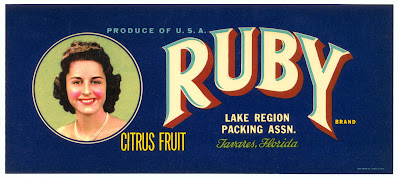
Citrus label families have even seen cross over into the Florida Citrus Queen competition. The Prevatt family featured Ruby Prevatt on their Ruby label. The Ruby brand was a part of the Lake Region Packing Association and was owned and operated by the Prevatt family. Ruby Prevatt was a part of the 1939 Florida Citrus Queen competition and was sponsored by the Tavares Woman’s Club. She is also the daughter of Florida Citrus Hall of Fame inductee Jennings Bryant “Babe” Prevatt.


Label advertisement and artwork played a large role in promoting the citrus industry. The ability to implement family members or scenes into the labels allows for a greater connection to customers and the importance of citrus in the family diet. 

All of the labels mentioned above and more can be viewed in the McKay Archives Citrus Label digital collection at https://archives.flsouthern.edu/digital/collection/labels/search/page/1


Written by Emily Allen, Florida Citrus Hall of Fame Fellow
In partnership with Florida Southern College’s McKay Archives Center
Spring 2024

---

Sources:

Calise, Gabrielle. “A Tampa Librarian Wants to Save Florida’s Vanishing Citrus Labels — And Her Family History.” Tampa Bay Times (St. Petersburg, Florida), March 16, 2021. https://www.tampabay.com/life-culture/history/2021/03/16/a-tampa-librarian-wants-to-save-floridas-vanishing-citrus-labels-and-her-family-history/

[Miss Ruby Prevatt]. The Orlando Sentinel (Orlando, Florida), January 22, 1939.


Thursday, March 14, 2024

From the Archives: Traveling Citrus in Egypt

In 1992, Dr. Prevatt visited the Nile Delta region of Egypt as a citrus expert for six weeks in May and June. During this time, he worked with the Agricultural Cooperative Development International program; the goal of this program was to create a line of dialogue between Egyptian and American farmers and researchers. Prevatt was selected to be the citrus expert because of his background knowledge in citrus. The main objective of his role was to help the growers in the region of interest with any issues they may be facing regarding their crops.
 

Upon arrival, Prevatt was tasked with determining what the major problems in the area were. He concluded that the region was plagued with poor irrigation, Phytophthora foot rot and psorosis were killing trees, lack of a hedging program, excessive use of chemical fertilizers, and closed plantings.
 

At the time, farmers had begun growing citrus in a region referred to as the “New Lands.” This area is made up of sandy desert soils. Other regions where citrus production takes place have silt soil. This means that the same farming practices cannot be used in both regions due to the differences in the soil. Silt soil is a combination of sand and clay. It is an extremely fertile type of soil because it is very good at water retention. Due to the aforementioned fertility of silt, it does not need to be fertilized often. Silt soil is one of the ideal soils for citrus production due to its loose form and drainage properties; Prevatt comments on the effects over-fertilization is having on the crops. For centuries, the Nile River would flood and deposit more silt on its banks. This flooding was later controlled by the production of the Aswan Dam in 1968. Sandy soil is made up of fine particles and is loosely packed. Due to this loose packaging, sandy soil tends to need to be fertilized because it does not hold on to nutrients well. Besides this, it is a good soil for citrus production as long as it is fertilized to ensure there are adequate nutrients present.
 

However, the biggest problem with citrus production in the New Lands is the lack of water. The Egyptian government was attempting to install canals and waterways to aid in agriculture. Due to a lack of funds and resources, the installation of these irrigation systems was not an easy one. Regardless, Dr. Prevatt made attempts to give help where applicable. Dr. Prevatt comments on an interaction he had with a farmer in Cairo. Upon meeting this farmer for what Prevatt thought was the first time, the farmer exclaimed “I know you” to Prevatt. After some discussion, they realized that the farmer had visited Florida Southern College years ago as part of a citrus exchange program. The Agricultural Cooperative Development International program has helped people all over the world and given people the opportunity to visit places they may have never seen.

Written by Tanzy Zviitwah, Florida Citrus Hall of Fame Fellow
In partnership with Florida Southern College’s McKay Archives Center
Spring 2024


--
 
Source:
 
Mack, Thomas B. History of the Citrus Institute, Florida Southern College, 1947-1993. Lakeland, Florida: Florida Southern College, 1993.

Thursday, March 7, 2024

From the Archives: Traveling Citrus in China


In 1986, Dr. Prevatt had the opportunity to visit China with 52 students from the Florida State Horticulture Society. During this trip, they experienced both Chinese culture and traditions while having the opportunity to learn about their governmental policy and produce.
 

The first leg of their trip was spent doing tourist-like activities and going to see major historical sites, including the city of Shanghai. Shanghai is a heavily populated city on the port of the Yangtze River, and it runs under an integrated society meaning the government ensures that all its people have work.
 

The group also took a trip to “The Garden City of the World” during this trip, and they were in awe of the artistry that was on display. Prevatt comments on how the people made intricate designs using different plants, rocks and the occasional waterfall.
 

Tourism was not the only goal of this trip; the group moved on to learn more about the various horticulture techniques used in China. Mandarin is the primary citrus grown in China. Most of the land in China has poor drainage meaning the soil does not dry out easily post irrigation. This can be disastrous to produce because it stops plants from being able to take up oxygen through the roots. To combat this, citrus trees are only grown on high beds of land - this helps in making drainage more efficient. Prevatt noted that the Chinese tend to do most farm work by hand with very little machinery to help.
 

This trip was made possible due to the help and cooperation of the U.S. China Exchange Center; they linked the group with a native tour guide to help them get a full experience of the area. Not only were they able to have one-on-one interactions with the farmers, but they also got to see countless historical sites. China is currently the leading producer of citrus in the world making up 28.77% of the world's citrus.

Written by Tanzy Zviitwah, Florida Citrus Hall of Fame Fellow
In partnership with Florida Southern College’s McKay Archives Center
Spring 2024


--
 
Source:
 
Mack, Thomas B. History of the Citrus Institute, Florida Southern College, 1947-1993. Lakeland, Florida: Florida Southern College, 1993.

Monday, February 26, 2024

From the Archives: Citrus Queens and Miss Florida Citrus


The Florida Citrus Queen pageant took place at the Florida Citrus Festival for the first time in 1924, so this year marks 100 years since the start of the competition. However, this first competition had a very different set up compared to the pageants that followed in the years to come.

Young men and women applied to be crowned as the Citrus King and Queen; Polk County residents then had the opportunity to vote for who they thought should be crowned. Both rulers were crowned at that year’s Citrus Festival and were featured as part of the citrus industry parade. Dorothy Williamson was crowned the first Citrus Queen and Harvey Henderson was crowned Citrus King. This was the only time a King would be crowned.

Following the 1924 competition, another queen was not crowned until 1930 when Ruth Snyder became Citrus Queen. However, the competitions that followed were very different from the first one. Women applied to be a part of the contest where they participated in a series of pageant events. The winner was then picked by a panel of judges. This choice was based on their talents, elegance, and philanthropic endeavors.

As the competition continued, the title began to come with numerous responsibilities and tasks. The Citrus Queen was the face of the citrus industry; she made radio, television, and newspaper appearances informing the public about the interests and concerns that the citrus industry had at the time. The competition took a break in the early 2000s and started back up again in 2015. The pageant is still running currently and will soon be celebrating its 100th anniversary at the Miss Florida Citrus Pageant on March 2, 2024.


Written by Tanzy Zviitwah, Florida Citrus Hall of Fame Fellow
In partnership with Florida Southern College’s McKay Archives Center
Spring 2024

--

Sources:

Mack, Thomas B. Citrifacts. Bartow, Florida: Associated Publications Corporation, 1992. 

1963 Florida Citrus Queen contestants at the Florida Citrus Exposition in Winter Haven
. 1963. State Archives of Florida, Florida Memory. https://www.floridamemory.com/items/show/343554.

Wednesday, January 31, 2024

From the Archives: Traveling Citrus in Europe

For five weeks in 1982, Professor Mack, along with six students, toured the common markets in Europe. The goal of this adventure was to see firsthand how citrus, among other fruits, was handled and marketed in major importing hubs in Europe. They visited a total of 7 countries including England, Belgium, The Netherlands, Germany, Switzerland, Spain, and France. 

While in England, they had the opportunity to see how apples were grown, produced, and sent out all over the continent. During their 4 week-long road trip across Europe, they spoke with buyers, marketers, and importers of Florida citrus specifically. They had the unique experience of seeing how these markets work behind the scenes. 

The goal of traveling to Spain was to observe the citrus growing styles and the research that was being done on citrus. Today, Spain is the leader in citrus production making up 56% of citrus production in Europe. Spain is well suited for citrus growth for a multitude of reasons, especially the climate as they have hot dry summers. However, this is paired with relatively cold winters, low humidity, and little rainfall, making irrigation a necessity. Although irrigation may be difficult, they are still able to produce large amounts of fresh fruit every year. 

This trip was not only spent learning about produce and how it is grown or marketed. Students had down time to learn more about the cultures and see historical land sites and monuments. In 1983, Mack orchestrated another tour of Europe; however, this one was not nearly as detailed as the tour the year before had been. Both tours gave students memories that most people can only dream of, and the memories they gained will hopefully last a lifetime. 
 
 
Written by Tanzy Zviitwah, Florida Citrus Hall of Fame Fellow
In partnership with Florida Southern College’s McKay Archives Center
Spring 2024

--

Sources:
 
Díaz, Sergio. “Citrus Fruit: A Leading Sector Despite the Complicated Context.” CaixaBank Research, October 4, 2022. https://www.caixabankresearch.com/en/sector-analysis/agrifood/citrus-fruit-leading-sector-despite-complicated-context.
 
Mack, Thomas B. History of the Citrus Institute, Florida Southern College, 1947-1993. Lakeland, Florida: Florida Southern College, 1993.
 

Wednesday, November 29, 2023

From the Archives: Traveling Citrus in New Zealand

Florida Southern College’s Citrus Institute aimed to give students not only an exceptional in-classroom education, but also a hands-on experience; with citrus groves planted all around campus, students had a learning experience unlike any other. The faculty were also well versed in the different techniques used all over the world thanks to their own hands on learning. Professor Tom Mack spent time in New Zealand in 1982 and spent his time abroad learning more about their citrus culture.
 
New Zealand is located on the limit for citrus culture and only on the northern and north eastern sections of the north island can citrus be feasibly grown. Ideal conditions for citrus include warm and sunny positions and temperature ranging from 50-55 degrees Fahrenheit; anything below 45 could possibly kill the plants. Upon hearing this, one can understand why Florida is the ideal place for citrus production. The lack of sunshine during the summers in New Zealand results in small, slow growing fruits, usually with poor yield.

During his time in 
New Zealand, Mack was able to see several similarities and differences in planting habits. The country is known for its strong winds in an effort to protect citrus cultures; they plant windbreakers which have been effective in sheltering the plants up to a specific distance. They also grew citrus crops on significantly smaller areas in order to grow more plants per the area to secure a reasonable income for the grower. They did not have significant issues with pests or diseases killing crops, but they continue to take precautions to ensure that this remains the reality. Mack remarks on the fumigation process that takes place the moment an airplane lands in the country.

New Zealand is far from being one of the world's top producers in citrus, but they are well on their way in kiwifruit. Growers in different parts of the country were seen to be growing kiwifruit in between the citrus plantings in the hopes of cutting down the citrus trees once the kiwifruit has matured. Mack ends his account commenting on how the New Zealand citrus industry will never be a threat to the Florida citrus grower. Currently,  New Zealand makes up about 0.05% of the world's citrus production. Safe to say, Professor Mack was right in his conclusion.


Written by Tanzy Zviitwah, Florida Citrus Hall of Fame Fellow
In partnership with Florida Southern College’s McKay Archives Center
Fall 2023


--

Source:

Mack, Thomas B. History of the Citrus Institute, Florida Southern College, 1947-1993. Lakeland, Florida: Florida Southern College, 1993.

Monday, October 30, 2023

From the Archives: FSC Citrus Institute Chimeras

In History of the Citrus Institute, Professor Thomas B. Mack talks about how the citrus department was always trying to expand their audience past citrus majors and hit all sectors of campus life while engaging all students in one way or another. In the 1960s to 1980s, the citrus department created a “Plant of the Day” display that was placed between the citrus and physics wings. Chimeras were one of the most popular sites on display because of their humorous appearance. The citrus department created this display as an attempt to reach out and connect to the larger student body that were not involved with the citrus department.

A chimera is a mutant that results from an organism that has cells where two different genes are present causing them to both be expressed in the cell. This can be seen in a variety of organisms; for example, a rose can be half red and half white because it has both genes that are coding for the color white and for the color red being expressed.

A chimera is also different from a hybrid because of how the cells are oriented. A hybrid is an organism that has genes from two different species coexisting within one cell while a chimera has genes from two different species existing in separate cells. This means the tissue, the body of the cells, in a chimera are made from genes of two different organisms.

A specific chimera collected in the citrus department had an usually large section making it resemble a cantaloupe. As an April Fool’s prank, the department decided to name it the Orange-A-Loupe and convinced non-citrus majors they had created a cross between an orange and a cantaloupe, an impossible feat. Along with the Orange-A-Loupe, there were several other humorous chimeras placed on display for all of campus to see. 


Written by Tanzy Zviitwah, Florida Citrus Hall of Fame Fellow
In partnership with Florida Southern College’s McKay Archives Center
Fall 2023

-- 

Source: 

Mack, Thomas B. History of the Citrus Institute, Florida Southern College, 1947-1993. Lakeland, Florida: Florida Southern College, 1993.


Friday, September 29, 2023

From the Archives: Citrifacts!

The “From the Archives'' series is back! In these blogs, we will be discussing the history of Florida Southern College’s Citrus Institute as well as some of Professor Tom Mack’s personal endeavors.
 
To start us off, we will be discussing Citrifacts. In September 1983, Prof. Mack wrote the first Citrifact column in the Citrus Industry magazine. This column was seen monthly in the magazine from 1983 until 1999. This column continued to be seen in the magazine as space permitted under the title “It’s a Citrifact,” referencing the original Citrifact column from the ‘80s. It presumably ceased to be published in 2004 following the death of Prof. Mack. This column was used to give some piece of information on citrus whether it was background on an existing system or new information that was recently published. The first Citrifact was about the origin of citrus concentrate in 1920. This article explains how Dr. J. E. Crump, a veterinarian and citrus grower, was the first to produce citrus concentrate in an ice cream freezer. 
 
Citrus concentrate is a powdered juice that can be used to make things taste like citrus. The production of citrus concentrate was a game changer for the citrus industry because this allowed growers the ability to sell citrus year-round. As the citrus industry grew larger and larger, growers began to look for more ways to store excess crops; this is where concentrate comes into the picture. 
 
Creating concentrate is a multi-step process. After harvesting, the fruits are juiced, and the juice is collected. The juice is then strained leaving a clear liquid and is evaporated to remove any water from the solution. This liquid is then deoxygenated meaning all dissolved oxygen is removed from solution; this is done to prevent oxidation from taking place because oxidation can cause rotting. The product then goes through another round of evaporation; it is then cooled and packed away in storage for later use. When it is time to use, the concentrate can be rehydrated by the addition of water.
 
 
Written by Tanzy Zviitwah, Florida Citrus Hall of Fame Fellow
In partnership with Florida Southern College’s McKay Archives Center
Fall 2023
-- 
 
Sources:
 
Mack, Thomas B. Citrifacts. Bartow, Florida: Associated Publications Corporation, 1992.
 
Powers, John Robert and Robert Sidney Moore, Barry Jay Anderson, Galen Edward Downton, Judith Ann Kennedy, Donald Raymond Kearney, and David Arthur Strang. 1983. Process for Preparing Citrus Juice Concentrate. European Patent EP0110638A2, filed November 18, 1983, and issued June 13, 1984. https://patents.google.com/patent/EP0110638A2/en.

Thursday, May 4, 2023

From the Archives: O.J. the Jumping Frog

In California during May 1965, an event would take place that would forge the story of an unlikely star. This event, referred to as the Calaveras County Frog Jump contest, was to be held on the 19th of the month to try and find the “jumpingest” frog in the world. This was where a star was born. Captured the Monday before his big event, Polk County’s champion was pampered at Dick Pope Sr.’s Cypress Garden by water skiers in an attempt to train him to hop over water. These skiers also wanted to build up the ego of the frog, so that he would have the confidence required to bring home the gold medal. To inflate his amphibious ego further, he gained sponsorship from the Florida Citrus Commission who planned to keep him pampered and fresh. After his intense training, the frog was airlifted from Tampa to Sacramento to take place in his jump. Dubbed the name O.J., for it was claimed he was trained on orange juice that increased his advantage by 500%, the frog that was unknown just 24 hours before had the fate of Polk County’s fame relying on his giant legs. The day of the event came, and through over half the event, it seemed as though O.J.’s name would go down in frog history. Steadily moving towards the top of the ranking, everything was going his way. Sadly, however, his 9 foot, 1¾ inch leap was not enough, for a few frogs beat him out for spots in the international competition. Even with the loss, it was thought O.J. would win the honor of longest traveled frog to compete, but an amphibian hailing from Africa would claim that prize. Even though he fell short of his ultimate goal, that he learned of a mere 48 hours before, O.J. could still be proud that he was the “jumpingest” frog in the history of Polk County. With that honor, O.J. retired. His inspiring and legendary career was over after just two short days. O.J. settled down in Angel’s Camp, California and planned to live out the rest of his days in seclusion, but the limelight was not yet done with the superstar jumper. Scandal arose from Angel’s Camp as rumors about O.J. being romantically involved with California frogs hit the papers. His jockey, Mrs. Hildred Cooper, reported that O.J.’s decision to step away from jumping had more to do with the Californian succubi of frogs O.J. had been around than retiring for the peace of it. With that news leaked to the press, the Florida Citrus Commission launched a probe into the private life of O.J. the frog. When reached out to by The Ledger frog editor, who spoke the native tongue of the frog, O.J. only had one thing to say about the rumors: “Nothin’ to it, nothin’ to it at all. I just shared a few flies with them. What’sa matter anyway? You don’t trust me or somethin’?” With the scandal put down and his name restored, O.J. lived the rest of his life in the peace he desired.


Written by Blake Hale, Florida Citrus Hall of Fame Fellow
In partnership with Florida Southern College’s McKay Archives Center
May 2023

-- 

Source:
Frog Contest, 1965, James A. Haley Papers, 1948-1977, Box 123 Folder 13, Sarah D. and L. Kirk McKay, Jr. Archives Center, Florida Southern College, Lakeland, Florida.