Thursday, March 21, 2024

From the Archives: Citrus Families and Citrus Labels

Crate labels have a long-standing history in the Florida Citrus Industry illustrating important objects, people or landscapes to the specific brand and grower’s association. This can be seen in many labels that illustrate different family members of Citrus company owners. 

One example of this is the Baby-Ade label. The label features a baby with an orange and a tropical landscape. The baby on the label is a part of the Lee family - the father of Elizabeth Lee Barron. The Baby-Ade brand was a part of the Lee family corporation out of Tampa, Florida. This citrus company grew and processed oranges, grapefruits, and tangerines. Many of the other Lee family members were also featured on their company’s label including Aunt Miriam, Aunt Rosemary, Aunt Rowen Katherine, and even the family dog named Juno, also known as “Goo Goo.” 


Citrus label families have even seen cross over into the Florida Citrus Queen competition. The Prevatt family featured Ruby Prevatt on their Ruby label. The Ruby brand was a part of the Lake Region Packing Association and was owned and operated by the Prevatt family. Ruby Prevatt was a part of the 1939 Florida Citrus Queen competition and was sponsored by the Tavares Woman’s Club. She is also the daughter of Florida Citrus Hall of Fame inductee Jennings Bryant “Babe” Prevatt.
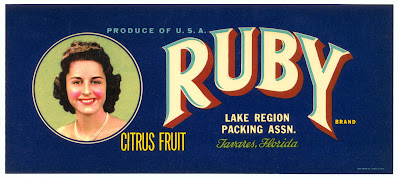

Label advertisement and artwork played a large role in promoting the citrus industry. The ability to implement family members or scenes into the labels allows for a greater connection to customers and the importance of citrus in the family diet. 

All of the labels mentioned above and more can be viewed in the McKay Archives Citrus Label digital collection at https://archives.flsouthern.edu/digital/collection/labels/search/page/1


Written by Emily Allen, Florida Citrus Hall of Fame Fellow
In partnership with Florida Southern College’s McKay Archives Center
Spring 2024

---

Sources:

Calise, Gabrielle. “A Tampa Librarian Wants to Save Florida’s Vanishing Citrus Labels — And Her Family History.” Tampa Bay Times (St. Petersburg, Florida), March 16, 2021. https://www.tampabay.com/life-culture/history/2021/03/16/a-tampa-librarian-wants-to-save-floridas-vanishing-citrus-labels-and-her-family-history/

[Miss Ruby Prevatt]. The Orlando Sentinel (Orlando, Florida), January 22, 1939.


Thursday, March 14, 2024

From the Archives: Traveling Citrus in Egypt

In 1992, Dr. Prevatt visited the Nile Delta region of Egypt as a citrus expert for six weeks in May and June. During this time, he worked with the Agricultural Cooperative Development International program; the goal of this program was to create a line of dialogue between Egyptian and American farmers and researchers. Prevatt was selected to be the citrus expert because of his background knowledge in citrus. The main objective of his role was to help the growers in the region of interest with any issues they may be facing regarding their crops.
 

Upon arrival, Prevatt was tasked with determining what the major problems in the area were. He concluded that the region was plagued with poor irrigation, Phytophthora foot rot and psorosis were killing trees, lack of a hedging program, excessive use of chemical fertilizers, and closed plantings.
 

At the time, farmers had begun growing citrus in a region referred to as the “New Lands.” This area is made up of sandy desert soils. Other regions where citrus production takes place have silt soil. This means that the same farming practices cannot be used in both regions due to the differences in the soil. Silt soil is a combination of sand and clay. It is an extremely fertile type of soil because it is very good at water retention. Due to the aforementioned fertility of silt, it does not need to be fertilized often. Silt soil is one of the ideal soils for citrus production due to its loose form and drainage properties; Prevatt comments on the effects over-fertilization is having on the crops. For centuries, the Nile River would flood and deposit more silt on its banks. This flooding was later controlled by the production of the Aswan Dam in 1968. Sandy soil is made up of fine particles and is loosely packed. Due to this loose packaging, sandy soil tends to need to be fertilized because it does not hold on to nutrients well. Besides this, it is a good soil for citrus production as long as it is fertilized to ensure there are adequate nutrients present.
 

However, the biggest problem with citrus production in the New Lands is the lack of water. The Egyptian government was attempting to install canals and waterways to aid in agriculture. Due to a lack of funds and resources, the installation of these irrigation systems was not an easy one. Regardless, Dr. Prevatt made attempts to give help where applicable. Dr. Prevatt comments on an interaction he had with a farmer in Cairo. Upon meeting this farmer for what Prevatt thought was the first time, the farmer exclaimed “I know you” to Prevatt. After some discussion, they realized that the farmer had visited Florida Southern College years ago as part of a citrus exchange program. The Agricultural Cooperative Development International program has helped people all over the world and given people the opportunity to visit places they may have never seen.

Written by Tanzy Zviitwah, Florida Citrus Hall of Fame Fellow
In partnership with Florida Southern College’s McKay Archives Center
Spring 2024


--
 
Source:
 
Mack, Thomas B. History of the Citrus Institute, Florida Southern College, 1947-1993. Lakeland, Florida: Florida Southern College, 1993.

Thursday, March 7, 2024

From the Archives: Traveling Citrus in China


In 1986, Dr. Prevatt had the opportunity to visit China with 52 students from the Florida State Horticulture Society. During this trip, they experienced both Chinese culture and traditions while having the opportunity to learn about their governmental policy and produce.
 

The first leg of their trip was spent doing tourist-like activities and going to see major historical sites, including the city of Shanghai. Shanghai is a heavily populated city on the port of the Yangtze River, and it runs under an integrated society meaning the government ensures that all its people have work.
 

The group also took a trip to “The Garden City of the World” during this trip, and they were in awe of the artistry that was on display. Prevatt comments on how the people made intricate designs using different plants, rocks and the occasional waterfall.
 

Tourism was not the only goal of this trip; the group moved on to learn more about the various horticulture techniques used in China. Mandarin is the primary citrus grown in China. Most of the land in China has poor drainage meaning the soil does not dry out easily post irrigation. This can be disastrous to produce because it stops plants from being able to take up oxygen through the roots. To combat this, citrus trees are only grown on high beds of land - this helps in making drainage more efficient. Prevatt noted that the Chinese tend to do most farm work by hand with very little machinery to help.
 

This trip was made possible due to the help and cooperation of the U.S. China Exchange Center; they linked the group with a native tour guide to help them get a full experience of the area. Not only were they able to have one-on-one interactions with the farmers, but they also got to see countless historical sites. China is currently the leading producer of citrus in the world making up 28.77% of the world's citrus.

Written by Tanzy Zviitwah, Florida Citrus Hall of Fame Fellow
In partnership with Florida Southern College’s McKay Archives Center
Spring 2024


--
 
Source:
 
Mack, Thomas B. History of the Citrus Institute, Florida Southern College, 1947-1993. Lakeland, Florida: Florida Southern College, 1993.

Monday, February 26, 2024

From the Archives: Citrus Queens and Miss Florida Citrus


The Florida Citrus Queen pageant took place at the Florida Citrus Festival for the first time in 1924, so this year marks 100 years since the start of the competition. However, this first competition had a very different set up compared to the pageants that followed in the years to come.

Young men and women applied to be crowned as the Citrus King and Queen; Polk County residents then had the opportunity to vote for who they thought should be crowned. Both rulers were crowned at that year’s Citrus Festival and were featured as part of the citrus industry parade. Dorothy Williamson was crowned the first Citrus Queen and Harvey Henderson was crowned Citrus King. This was the only time a King would be crowned.

Following the 1924 competition, another queen was not crowned until 1930 when Ruth Snyder became Citrus Queen. However, the competitions that followed were very different from the first one. Women applied to be a part of the contest where they participated in a series of pageant events. The winner was then picked by a panel of judges. This choice was based on their talents, elegance, and philanthropic endeavors.

As the competition continued, the title began to come with numerous responsibilities and tasks. The Citrus Queen was the face of the citrus industry; she made radio, television, and newspaper appearances informing the public about the interests and concerns that the citrus industry had at the time. The competition took a break in the early 2000s and started back up again in 2015. The pageant is still running currently and will soon be celebrating its 100th anniversary at the Miss Florida Citrus Pageant on March 2, 2024.


Written by Tanzy Zviitwah, Florida Citrus Hall of Fame Fellow
In partnership with Florida Southern College’s McKay Archives Center
Spring 2024

--

Sources:

Mack, Thomas B. Citrifacts. Bartow, Florida: Associated Publications Corporation, 1992. 

1963 Florida Citrus Queen contestants at the Florida Citrus Exposition in Winter Haven
. 1963. State Archives of Florida, Florida Memory. https://www.floridamemory.com/items/show/343554.

Wednesday, January 31, 2024

From the Archives: Traveling Citrus in Europe

For five weeks in 1982, Professor Mack, along with six students, toured the common markets in Europe. The goal of this adventure was to see firsthand how citrus, among other fruits, was handled and marketed in major importing hubs in Europe. They visited a total of 7 countries including England, Belgium, The Netherlands, Germany, Switzerland, Spain, and France. 

While in England, they had the opportunity to see how apples were grown, produced, and sent out all over the continent. During their 4 week-long road trip across Europe, they spoke with buyers, marketers, and importers of Florida citrus specifically. They had the unique experience of seeing how these markets work behind the scenes. 

The goal of traveling to Spain was to observe the citrus growing styles and the research that was being done on citrus. Today, Spain is the leader in citrus production making up 56% of citrus production in Europe. Spain is well suited for citrus growth for a multitude of reasons, especially the climate as they have hot dry summers. However, this is paired with relatively cold winters, low humidity, and little rainfall, making irrigation a necessity. Although irrigation may be difficult, they are still able to produce large amounts of fresh fruit every year. 

This trip was not only spent learning about produce and how it is grown or marketed. Students had down time to learn more about the cultures and see historical land sites and monuments. In 1983, Mack orchestrated another tour of Europe; however, this one was not nearly as detailed as the tour the year before had been. Both tours gave students memories that most people can only dream of, and the memories they gained will hopefully last a lifetime. 
 
 
Written by Tanzy Zviitwah, Florida Citrus Hall of Fame Fellow
In partnership with Florida Southern College’s McKay Archives Center
Spring 2024

--

Sources:
 
Díaz, Sergio. “Citrus Fruit: A Leading Sector Despite the Complicated Context.” CaixaBank Research, October 4, 2022. https://www.caixabankresearch.com/en/sector-analysis/agrifood/citrus-fruit-leading-sector-despite-complicated-context.
 
Mack, Thomas B. History of the Citrus Institute, Florida Southern College, 1947-1993. Lakeland, Florida: Florida Southern College, 1993.
 

Monday, January 29, 2024

From the Archives: Traveling Citrus in Mexico

Dr. Rubert Prevatt and Professor Tom Mack spent a month in Texas in the 1980s. During this time, they crossed the border into Mexico to learn more about one of the world's top citrus producers. The goal of this trip was to observe how they were combating the different obstacles they faced due to the climate in Mexico.  They visited the Campo Agricola Experimental Station where they were able to view all the experiments that were currently being practiced.

The regions where citrus is grown are notoriously arid, extremely dry, and to combat this, they use flood irrigation. This is an extremely wasteful irrigation style as it uses significantly more water than other irrigation methods. During flood irrigation, the land flood gates are opened allowing a large body of water to flow into the area this creates several disadvantages: 80% of the water is being lost as run off or evaporation, all sections of land do not receive the same amounts of water, which may cause anaerobic conditions in the soil. Because the soil is over saturated with water, this can cut off access to oxygen making respiration difficult for plants. Plants are only able to take up oxygen through their roots, but if there is no oxygen in the soil, the plant becomes void of oxygen.

The farmers at Campo Agricola were working on implementing a different irrigation system that would be more cautious of how they used the available resources. Their main focuses were seeing if they could use less water during the flooding and if they could use sprinkling or drip irrigation; as you can imagine, this method uses significantly less water than flood irrigation. With all the issues they face, one would not expect the Mexican citrus industry to be as big as it is. Mack comments on how he foresees the industry continuing to improve as the years pass. Mack was correct in his views, citrus production in Mexico has been steadily increasing over the years. Currently, Mexico produces 7.7% of the world's citrus.


Written by Tanzy Zviitwah, Florida Citrus Hall of Fame Fellow
In partnership with Florida Southern College’s McKay Archives Center
Spring 2024


--

Source:

Mack, Thomas B. History of the Citrus Institute, Florida Southern College, 1947-1993. Lakeland, Florida: Florida Southern College, 1993.

Wednesday, November 29, 2023

From the Archives: Traveling Citrus in New Zealand

Florida Southern College’s Citrus Institute aimed to give students not only an exceptional in-classroom education, but also a hands-on experience; with citrus groves planted all around campus, students had a learning experience unlike any other. The faculty were also well versed in the different techniques used all over the world thanks to their own hands on learning. Professor Tom Mack spent time in New Zealand in 1982 and spent his time abroad learning more about their citrus culture.
 
New Zealand is located on the limit for citrus culture and only on the northern and north eastern sections of the north island can citrus be feasibly grown. Ideal conditions for citrus include warm and sunny positions and temperature ranging from 50-55 degrees Fahrenheit; anything below 45 could possibly kill the plants. Upon hearing this, one can understand why Florida is the ideal place for citrus production. The lack of sunshine during the summers in New Zealand results in small, slow growing fruits, usually with poor yield.

During his time in 
New Zealand, Mack was able to see several similarities and differences in planting habits. The country is known for its strong winds in an effort to protect citrus cultures; they plant windbreakers which have been effective in sheltering the plants up to a specific distance. They also grew citrus crops on significantly smaller areas in order to grow more plants per the area to secure a reasonable income for the grower. They did not have significant issues with pests or diseases killing crops, but they continue to take precautions to ensure that this remains the reality. Mack remarks on the fumigation process that takes place the moment an airplane lands in the country.

New Zealand is far from being one of the world's top producers in citrus, but they are well on their way in kiwifruit. Growers in different parts of the country were seen to be growing kiwifruit in between the citrus plantings in the hopes of cutting down the citrus trees once the kiwifruit has matured. Mack ends his account commenting on how the New Zealand citrus industry will never be a threat to the Florida citrus grower. Currently,  New Zealand makes up about 0.05% of the world's citrus production. Safe to say, Professor Mack was right in his conclusion.


Written by Tanzy Zviitwah, Florida Citrus Hall of Fame Fellow
In partnership with Florida Southern College’s McKay Archives Center
Fall 2023


--

Source:

Mack, Thomas B. History of the Citrus Institute, Florida Southern College, 1947-1993. Lakeland, Florida: Florida Southern College, 1993.